
Brooks County Projected vs Actual
TDCJ defines Projected Release Date as the date its Classification and Records Office expects an inmate to leave incarceration if parole does not occur first. It is an administrative forecast for state custody. It is not a Brooks County Sheriff's estimate and is not the date shown on the later release certificate.
A person awaiting trial at Brooks County Jail generally has no set release date. Bond can be posted, a judge may act, a charge can be dismissed, or another hold can prevent exit. A county sentence has a different calculation from a TDCJ prison sentence. Determine the system before interpreting any date.
Find Brooks County Projected Release Dates
Start with the Brooks County cause and last known facility. TDCJ is the state prison system, not Brooks County Jail. The official search includes current state inmates and updates on working days with data at least a day old, so disappearance is not a reliable actual-release record.
- Call Brooks County Jail for the terminal status of a local booking, including any transfer destination.
- Read the court judgment, sentence, jail-credit entry, and all related holds.
- If the person entered state prison, search TDCJ by its seven-digit number or match name results with all identifiers.
- Record the Projected Release Date, location, offense, and update context exactly.
- Check Board parole information separately. Eligibility and approval are not release.
- Near the date, reconfirm with TDCJ or the jail and obtain the completed release record afterward.
If the former state prisoner no longer appears, email TDCJ with the full name and TDCJ number, or use exact birth date or approximate age and county of conviction. Ask for incarceration history and the actual release or discharge date. The Brooks County released inmate record path explains how to match that state history with the county cause.
The TDCJ email information page shows the fields and projected-date explanation:
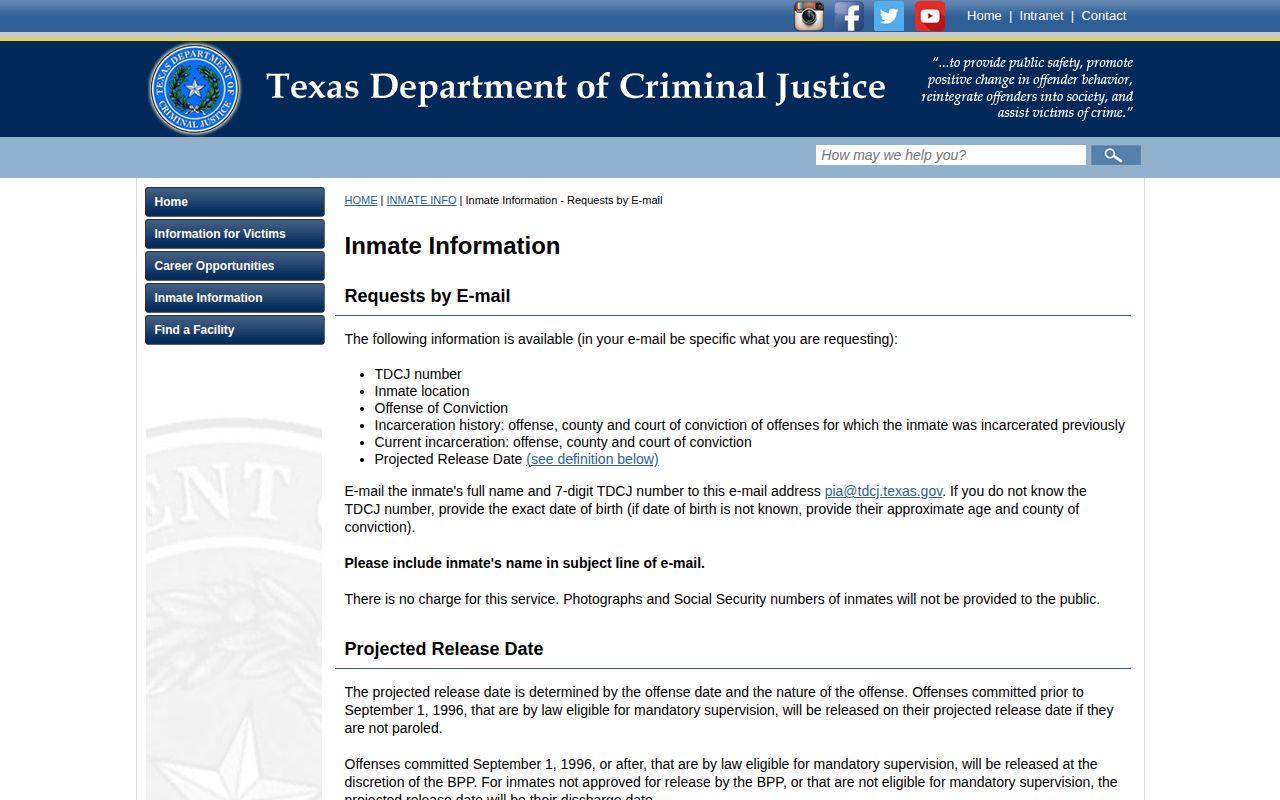
This no-charge information channel does not provide inmate photographs or Social Security numbers.
Texas State Release Date Credits
Government Code Chapter 498 governs TDCJ classification and good-conduct time. Section 498.003 concerns classifications and awards, while Section 498.004 addresses forfeiture and restoration. Section 498.005 explains that good time applies to eligibility as law provides and does not otherwise cut the sentence itself.
Credits can change because of classification, discipline, restoration rules, sentence corrections, or a new legal event. Parole eligibility is also distinct from projected discharge. For many otherwise eligible inmates, Section 508.145(f) uses calendar time plus good-conduct time equal to one-fourth of the sentence or fifteen years, whichever is less. Listed serious offenses under Section 508.145(d) generally use actual calendar time equal to one-half of the sentence or thirty years, whichever is less, without good time in that initial threshold. Other offenses and sentence types have special rules.
Texas has no safe universal “85 percent” formula for state parole. Offense, date, sentence, deadly-weapon finding, calendar time, credit, exclusions, and Board discretion all matter. Eligibility starts review. It does not guarantee release.
Why Brooks County Release Dates Move
A date can move in either direction, and the public screen may lag the internal record. Recheck the “last updated” context before making plans around a forecast.
| Factor | Possible effect |
|---|---|
| Discipline or classification | Good time can be forfeited, restored, or recalculated |
| Court correction | Sentence or jail credit can change |
| Board action | Parole may precede the projection or be denied |
| Program requirement | Completion can be required before release |
| Detainer or warrant | Another custodian can block community release |
| New case or sentence | A different legal basis for custody can become active |
A favorable Board vote can still require a valid residence plan, program completion, detainer resolution, and final Review and Release Processing. Record the exact vote code and do not reduce all outcomes to “granted” or “denied.”
Confirm Brooks County Release Dates
For county custody, ask Brooks County Jail for the exact release time, release reason, and destination. A transfer to TDCJ, another county, USMS, or ICE is a change of custodian, not return to the community. Match the response to the court order and receiving agency.
For state custody, use TDCJ release-status channels after a favorable Board vote and request the actual release or discharge history. A Brooks County VINE inmate check may supply a pending custody alert if the agency participates, but an alert can lag and must be verified. TDCJ's confidential IVSS is a separate state-prison notification path.
Brooks County Jail Good Time
County jail time uses a different authority from TDCJ. Code of Criminal Procedure article 42.032 permits a sheriff to grant commutation for good conduct, industry, and obedience. The deduction may be no more than one day for each day of the original sentence actually served when no misconduct charge is sustained.
The words “may” and “not to exceed” are vital. The statute does not prove Brooks County awards the maximum in every case. Court-ordered jail credit, concurrent or consecutive terms, administrative calculations, warrants, and detainers also affect the result. Ask the sheriff for the calculation tied to the named booking and ask the court for the sentence and credit entries.
Note: A Texas state-prison calculator cannot establish the projected end of a Brooks County jail sentence.
Brooks County Mandatory Supervision Dates
TDCJ treats mandatory-supervision rules differently by offense date. For eligible offenses before September 1, 1996, TDCJ says a person not paroled is released on the projected date. For eligible offenses on or after that date, the Board has discretion. If a person is ineligible or not approved, TDCJ says the projected date becomes the discharge date.
Government Code Chapter 508, including Sections 508.147 through 508.149, controls this framework and its exclusions. Life sentences, capital cases, repeat cases, intoxication offenses, and other specialized categories can follow different rules. Read the actual offense date and statute rather than apply a shorthand percentage.
The TDCJ definition page provides the agency vocabulary shown here:
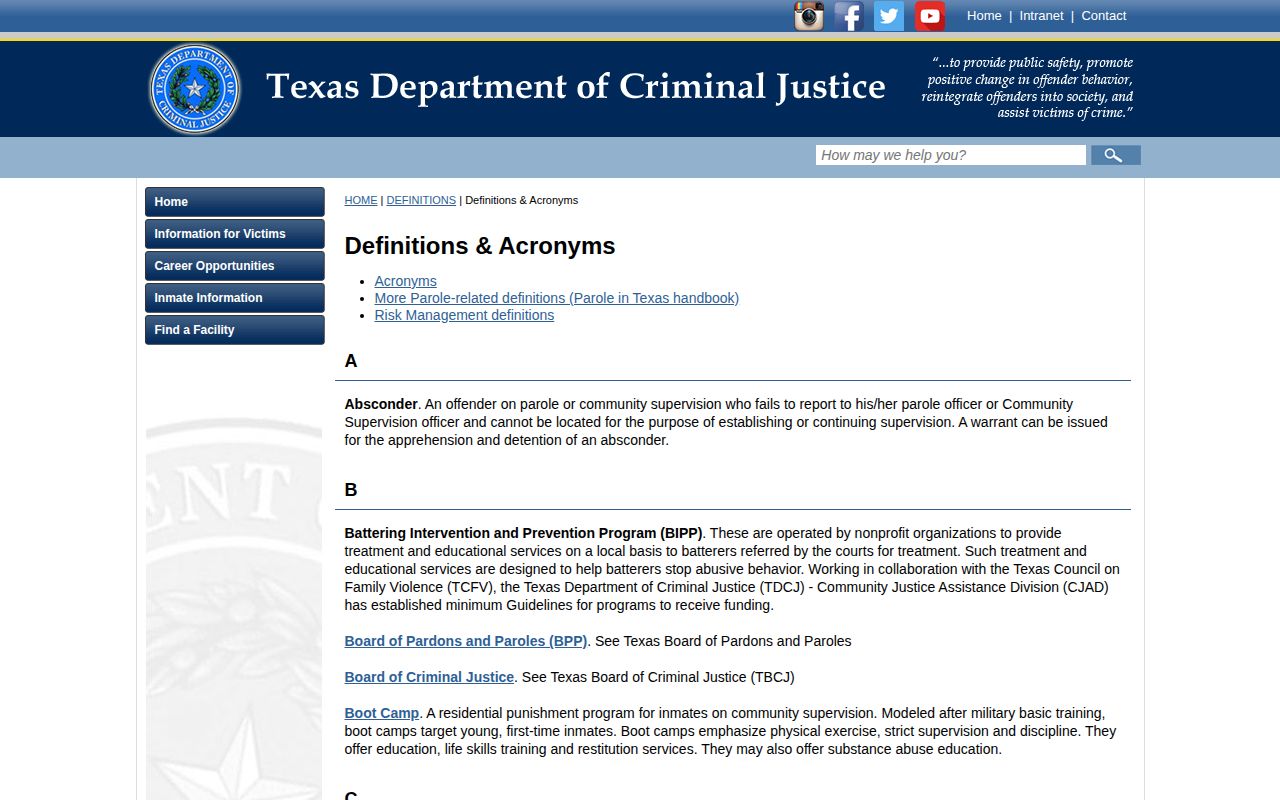
That vocabulary separates projection, parole, mandatory supervision, and discharge so one date is not mistaken for another.
Brooks County TDCJ Date Fields
The TDCJ online search works best with the seven-digit TDCJ number. A name search should be narrowed with sex, race, age, and other available identifiers. Brooks County may appear as the county of conviction even though the prison unit is elsewhere. Record the location, offense, projected date, and data-update context from the same matched record.
| Field | How it affects the lookup |
|---|---|
| TDCJ number | Best key for one state record |
| Location | Shows the current TDCJ unit, not Brooks County Jail |
| Offense and county | Helps match the state record to a Brooks County cause |
| Projected Release Date | Administrative forecast if parole does not occur sooner |
| Board information | Separate decision and review status |
The online search includes only people currently incarcerated in a TDCJ facility. If the person is absent, use the TDCJ email or telephone channels rather than treating the missing card as proof of discharge. TDCJ requests the full name and number. Without the number, it asks for exact birth date or approximate age plus county of conviction.
General information is also available at 936-295-6371 or 800-535-0283 during the listed business channel. Before a favorable vote, the Board review line is 844-512-0461. After a favorable vote, release-status staff use 512-406-5202. Supply the TDCJ or SID number and date of birth, and ask which stage the case has reached.
Brooks County Parole Eligibility Dates
A parole eligibility date is not a projected discharge date. The Board can begin file review before eligibility, and its panel may approve, deny, or impose a program-related outcome. A favorable vote can permit release at a stated stage, but TDCJ must still complete legal and administrative checks.
Use the live Board definition for each vote code. FI-1 and FI-2 have different favorable timing, while FI-3R, FI-4R, and other variants can require a program or transfer. RMS concerns release to mandatory supervision. NR denies release and sets later review information. A code should never be translated without checking the current official meaning.
Review and Release Processing verifies the residence plan, conditions, program completion, discipline, detainers, and legal eligibility before issuing a release certificate. A new warrant, unresolved hold, or failed plan can delay the gate date. The actual certificate and final TDCJ status are stronger proof than an earlier forecast or Board approval.
Brooks County Court Credit
The Brooks County judgment and docket can explain how a local sentence was built. Request the sentence, jail-time credit, and any correction order. Determine whether terms run at the same time or one after another. Also check for capias entries, revocation action, and holds connected to other causes.
“Time served” means the court or custodian credited or completed the custodial term reflected in that event. It does not resolve other cases. “Dismissed” ends a charge at that point but does not close unrelated causes. “Bond posted” can precede administrative processing and may not produce exit if another hold remains.
The jail's completed release transaction settles the final local timestamp. Ask for the booking number, release date and time, release reason, and destination agency. If the record says transfer, continue with the receiving custodian rather than recording that person as free.