
TDCJ Brooks County Release Paths
A Brooks County defendant enters the state system only after a court commits that person to TDCJ. The sheriff transfer ends county jail custody but is not a prison release. From that point, TDCJ Classification and Records controls the incarceration history and calculated dates. The Texas Board of Pardons and Paroles makes parole and discretionary mandatory-supervision decisions. TDCJ Parole Division coordinates approved releases and supervises people after they leave prison.
Three outcomes require different language. Parole is a conditional prison release approved by the Board before the sentence ends. Mandatory supervision is a separate statutory form of supervised release and can involve Board discretion. Discharge means the sentence and any supervision obligation have ended. A transfer between TDCJ units is none of these. The Brooks County release search helps trace the earlier county booking into the state record.
| TDCJ event | Meaning | Proof |
|---|---|---|
| Unit transfer | Prison custody continues | TDCJ location |
| Parole | Conditional supervised release | Board vote and certificate |
| Mandatory supervision | Statutory supervised release | Board/TDCJ record |
| Discharge | Sentence obligation ends | Classification and Records history |
Confirm a TDCJ Release
The online search is a current-incarceration tool. TDCJ states that it includes only people presently incarcerated in a TDCJ facility, updates on working days, and contains data at least 24 hours old. A missing record does not prove discharge. The person may have been released, transferred outside TDCJ, omitted due to timing, or affected by a record error. Use the screen as one stage, then request history.
- Search the official TDCJ inmate search by seven-digit TDCJ number when possible.
- If searching by name, compare sex, race, age, county of conviction, and other identifiers.
- Record the unit, offenses, projected release date, and last-update context exactly.
- Check the Board decision separately; approval is not the completed release event.
- Request actual release or discharge history from TDCJ when the person is no longer shown.
The official search capture below shows the fields and scope warning.
Open the TDCJ search source before reviewing its captured interface.
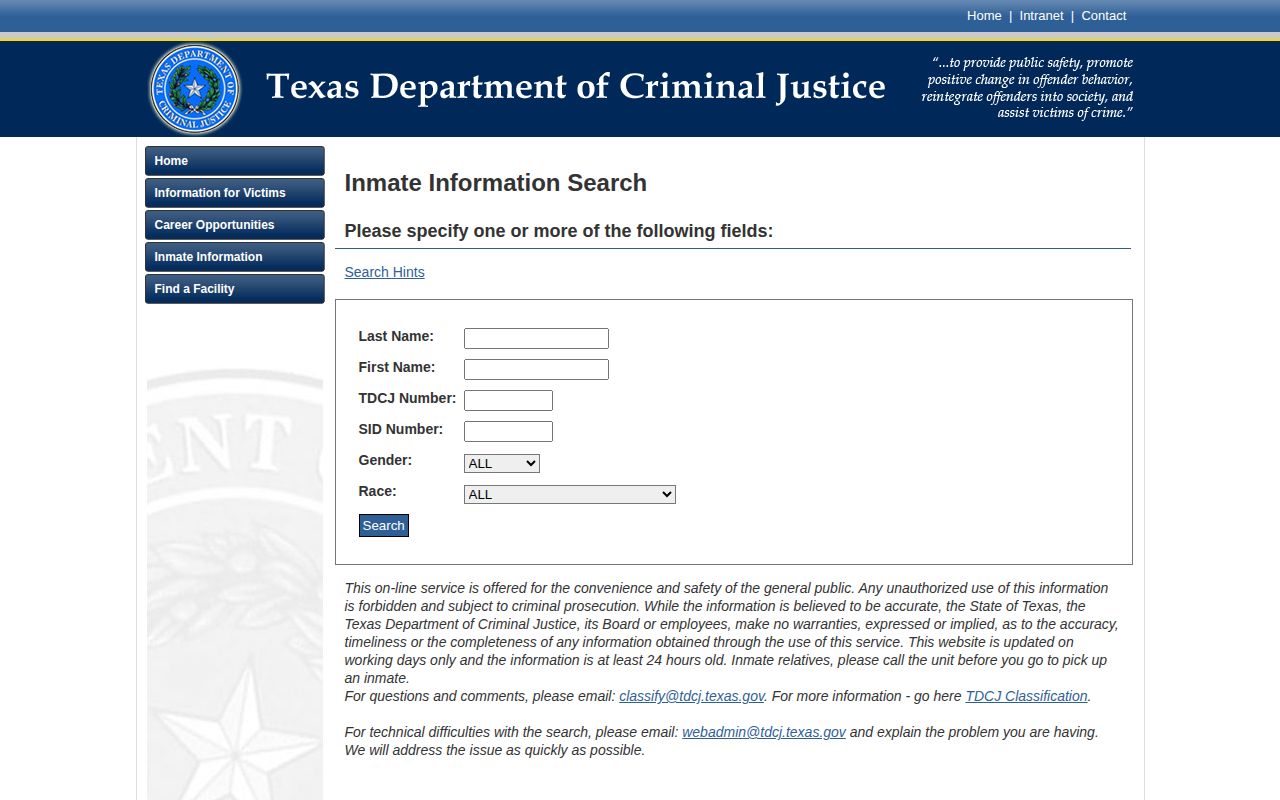
The image supports the current-inmate lookup route, while former-prisoner proof still requires the history channels.
TDCJ Release Records Contact
TDCJ accepts focused inmate-information requests by email. Provide full name and the seven-digit TDCJ number. If the number is unavailable, use exact date of birth; if that is also unknown, provide approximate age and Brooks County as the county of conviction. Ask specifically for the TDCJ number, incarceration history, actual release or discharge date, release type, and whether supervision remained. TDCJ states that this email information service is free.
Texas Department of Criminal JusticePO Box 99
Huntsville, TX 77342-0099
General information: (936) 295-6371 or (800) 535-0283
Email inmate information: pia@tdcj.texas.gov
Board review line before favorable vote: (844) 512-0461
Release-status staff after favorable vote: (512) 406-5202
Telephone requests work best with the TDCJ or SID number and date of birth. Public information can be limited, so ask for the specific historical field rather than private case details.
TDCJ Search Fields Explained
TDCJ's online information can show location, offenses, and Projected Release Date for a current prisoner. A projected date is a forecast calculated by Classification and Records. It is not a confirmed release timestamp. Parole may occur earlier, while a detainer, Board action, program, discipline, residence plan, sentence correction, or another legal event can change what happens.
| Field | Use | Limit |
|---|---|---|
| TDCJ number | Strongest state-system match | Seven digits required in some channels |
| SID | Texas identity match | Must match the correct person |
| County of conviction | Connects the prison case to Brooks | Not the prison location |
| Projected Release Date | Administrative forecast | Not actual release proof |
| Unit | Current TDCJ location | May change after transfer |
TDCJ says its public email service will not provide inmate photographs or Social Security numbers. That limit should not be bypassed by broadening an ordinary email request.
TDCJ Parole Decision Trail
The Board identifies eligible cases before review, an institutional parole officer prepares a summary, and a three-member panel votes. Two matching votes decide the case. A denial usually sets a later review date. An approval may still depend on a program, legal eligibility, release plan, conditions, discipline, or detainer review. TDCJ Review and Release Processing must complete those steps before issuing a certificate.
Record the exact vote date and code from the official decision channel. Do not reduce every favorable code to “released.” Some codes require a program or later date. After approval, contact release-status staff for the actual process. After the person leaves, use Parole Division to identify the assigned office. Brooks County cases map to the Laredo District Parole Office in Region IV, though public reporting details may be limited.
- Projected Release Date
- TDCJ's forecast if parole does not occur sooner.
- Parole eligibility
- The point at which review may occur, not a release promise.
- Certificate
- The release document issued after required processing.
- Discharge
- Completion of sentence and supervision obligations.
TDCJ Dates Are Not Fixed
Texas law does not support a universal claim that every state prisoner serves 85 percent. Government Code Chapter 508 uses offense, offense date, sentence, deadly-weapon findings, calendar time, good time, and eligibility rules. Section 508.145(d) applies a one-half sentence or 30-year calendar-time framework to listed serious offenses, with further limits. Section 508.145(f) uses calendar time plus good-conduct time for many other eligible cases. Eligibility is not release.
Government Code Chapter 498 governs classification and good-conduct time. Credits can be forfeited, restored under rules, or affected by classification. A court correction, new sentence, warrant, detainer, required program, or Board action can also move the practical date. Confirm again near the projected event and request the actual history afterward.
No TDCJ Unit in Brooks
No TDCJ prison unit was identified inside Brooks County. A state sentence sends the defendant away from the county jail to a unit assigned by TDCJ. That local fact changes where records requests go. The Brooks County court judgment proves commitment and sentence terms. The sheriff record proves the transfer from local custody. TDCJ then proves prison locations, calculated dates, and release or discharge.
Do not send a visitor or records request to the Brooks County Jail based on a later TDCJ result. Confirm the current unit through official inmate information. Likewise, a Brooks County conviction field does not mean the person remains housed in Brooks County. County of conviction and place of confinement are separate data points.
TDCJ Release Proof Sequence
Build the timeline in order: Brooks County judgment, sheriff transfer, TDCJ intake and unit history, Board decision if any, Review and Release Processing, actual release certificate or discharge date, then parole supervision where applicable. Each event belongs to a different custodian. A complete answer preserves those boundaries.
If records conflict, contact the office that created the disputed field. A judgment error belongs with the clerk and court. A prison date calculation belongs with TDCJ Classification and Records. A supervision assignment belongs with Parole Division. Written corrections should identify the TDCJ number, cause number, exact field, and supporting order without adding unnecessary sensitive information.
Note: The final TDCJ release record, not disappearance from the live search, establishes when state prison custody ended.